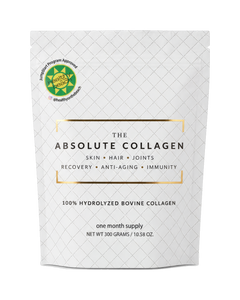
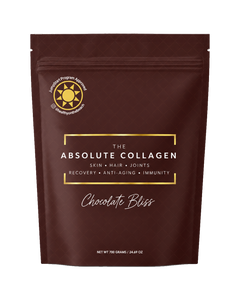
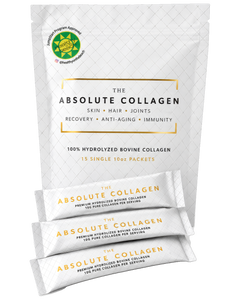
The Science
The science behind the results.
Collagen is the most abundant protein in the human body, making up the structural matrix of your skin, hair, nails, joints, bones, and connective tissue. Starting around age 25, your body's collagen production declines by approximately 1% each year.
By 50, you've lost roughly a quarter of what you started with. The effects are gradual but cumulative: skin loses elasticity, hair thins, joints become less resilient.
Daily supplementation with hydrolyzed collagen peptides is one of the most evidence-supported approaches to slowing and partially reversing this decline.
What collagen does
Benefits you can feel and see.
Skin Elasticity
Collagen forms the structural matrix that keeps skin firm, supple, and resilient. Daily peptides support fibroblasts that produce new collagen from within.
Studies link hydrolyzed collagen to improved skin hydration and elasticity over 8 to 12 weeks of consistent use.
Stronger Hair & Nails
The amino acids in collagen are building blocks for keratin, the protein that gives hair and nails their strength and structure.
Consistent intake supports thicker-feeling hair and reduces nail brittleness over time.
Joint and Bone Support
Type I and Type III collagen are major components of cartilage and bone matrix, cushioning joints and supporting skeletal integrity.
Daily collagen helps maintain joint comfort and mobility as natural production declines with age.
Muscle Recovery
Glycine, a key collagen amino acid, supports overnight repair and is a precursor to creatine, fueling energy metabolism in muscle.
Collagen complements a balanced protein intake to aid recovery after activity.
Highly absorbable peptides
Not all collagen is created equal.
The most important thing to understand about collagen supplementation is that the source and processing method determine everything.
The Absolute Collagen is hydrolyzed, meaning the collagen protein has been enzymatically broken down into small peptide fragments. These fragments contain a collagen-specific amino acid called hydroxyproline, which is found almost exclusively in collagen and connective tissue. Unlike most amino acids, hydroxyproline cannot be broken down by stomach acid. It passes directly into the bloodstream, where it signals your body to stimulate new collagen synthesis.
This is why topical collagen products cannot address collagen depletion from within. And this is why source quality matters: bovine collagen naturally contains higher concentrations of hydroxyproline than marine alternatives. Our cattle are grass-fed and grass-finished. Every lot is third-party tested for heavy metals and microbiological safety.
The Amino Acid Profile
The building blocks of collagen.
Collagen is composed primarily of three amino acids that work together to form the collagen triple helix. Together, glycine, proline, and hydroxyproline account for approximately 57% of total collagen content.
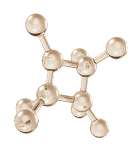
Glycine
The most abundant amino acid in collagen, representing roughly 33% of total amino acid content.
Glycine supports lean muscle protein synthesis, plays a role in the body's overnight repair and recovery processes, supports liver detoxification, and contributes to gut barrier integrity. It is also a precursor to creatine, which supports energy metabolism in muscle tissue.
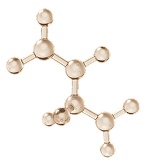
Proline
Makes up approximately 12% of collagen's amino acid content. Proline is essential for the synthesis of new collagen and plays a critical role in wound healing, cartilage repair, and maintaining the structural integrity of skin.
It is a conditionally essential amino acid, meaning the body can produce it, but not always in quantities sufficient to support collagen synthesis at scale.
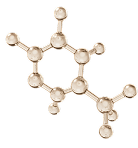
Hydroxyproline
The most distinctive collagen amino acid, and the one that makes ingested collagen truly unique as a supplement.
Hydroxyproline is found almost exclusively in collagen and connective tissue. It is created by hydroxylation of proline within the collagen molecule, and this modification is what gives the collagen structure its remarkable thermal stability and strength.
Most importantly: stomach acid cannot break hydroxyproline peptides down. They pass directly into the bloodstream intact, where they signal fibroblasts — the cells responsible for producing new collagen — to increase their output. This is the biological mechanism behind why ingesting hydrolyzed collagen works when topical collagen does not.
Bovine collagen contains higher concentrations of hydroxyproline than marine collagen. Grass-fed and grass-finished bovine hides are among the richest natural sources of Type I and Type III collagen available. This is why source matters.
Sourcing and Testing
Sourcing you can trust.
The Absolute Collagen is derived from the hides of grass-fed, grass-finished cattle. Grass-fed means the animals were raised on pasture rather than grain. Grass-finished means they were never transitioned to a grain-fed feedlot for final weight gain, which is the standard practice in conventional beef production. This distinction matters for the amino acid quality of the collagen and for the overall integrity of the supply chain.
Every production lot of The Absolute Collagen is independently third-party tested for heavy metals, including lead, arsenic, cadmium, and mercury, and for microbiological safety. We test every lot. Our OU Kosher Parve certification requires rigorous inspection at every step of sourcing, production, and packaging.
- Grass-Fed & Grass-Finished
- Third-Party Tested Every Lot
- OU Kosher Parve Certified
- Rigorous Inspection
- Transparency in Every Step